Address
304 North Cardinal
St. Dorchester Center, MA 02124
Work Hours
Monday to Friday: 7AM - 7PM
Weekend: 10AM - 5PM
Address
304 North Cardinal
St. Dorchester Center, MA 02124
Work Hours
Monday to Friday: 7AM - 7PM
Weekend: 10AM - 5PM

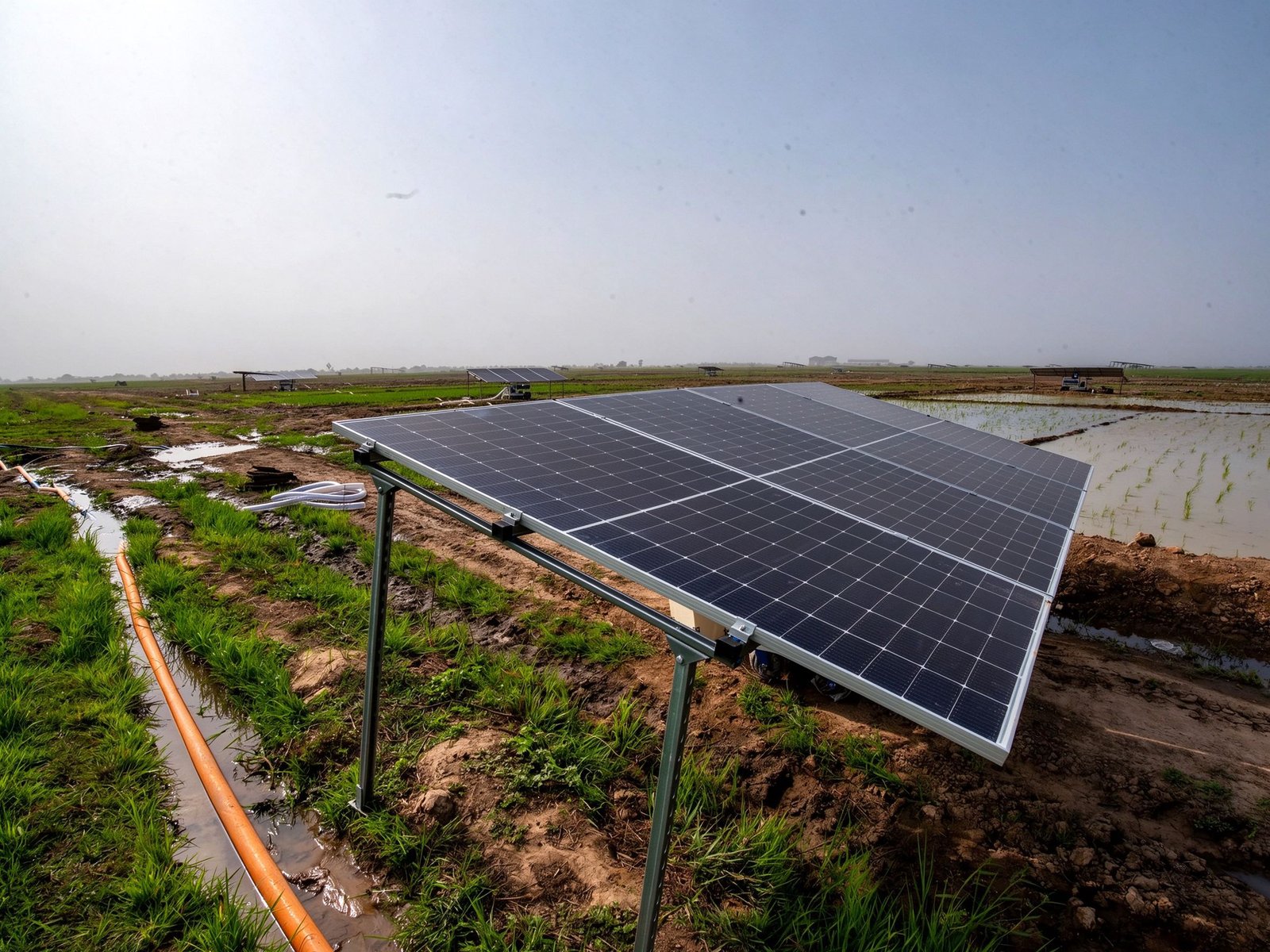
Sizing a solar irrigation pump comes down to three numbers: how much water you need per day, how high you have to lift it, and how many sun hours your site gets. Get these right and the pump delivers reliable water through daylight hours. Get them wrong and you either overspend on panels that sit idle or under-specify a pump that cannot keep up with peak demand.
This guide walks through the sizing steps, compares submersible and surface pump options, and gives a practical method for matching pump power to panel wattage. The sizing method follows standard pump engineering practice (the hydraulic power formula used by pump manufacturers such as Grundfos) and the FAO/GIZ solar pumping design workflow, so you can repeat the same calculation on your own site.
A solar irrigation pump is sized in three sequential steps. Do them in order; each step depends on the one before it.
Step 1:
Calculate your daily water demand. Add up the water each crop or livestock group needs, then multiply by the peak number of days between irrigations. This gives the total volume per day the pump must deliver.
Step 2:
Calculate total dynamic head. This is the vertical lift from the water level to the outlet, plus friction loss in the pipe, plus any pressure required at the emitters (drip, sprinkler or flood).
Step 3:
Match pump power to head and flow. Use the standard hydraulic power formula: shaft power in kW = (flow in m3/h x head in m) / (367 x pump efficiency). The constant 367 comes from converting m3/h to m3/s and multiplying by gravitational acceleration (3600 / 9.81). Assume 0.55 to 0.65 efficiency for a submersible borehole pump, then multiply the result by 1.25 to 1.3 for panel derating and pipe friction.
The table below gives typical planning ranges. Actual demand varies by crop type, soil, climate and irrigation method, so treat it as a starting point rather than a specification.
| Farm Size | Typical Daily Demand | Recommended Flow | Typical Head Range | Pump Power Range |
| 1 hectare (2.5 acres) | 20-40 m3/day | 2-5 m3/h | 30-120 m | 1.5-3.0 kW |
| 5 hectares (12 acres) | 100-200 m3/day | 8-14 m3/h | 40-150 m | 3.0-7.5 kW |
| 10 hectares (25 acres) | 200-400 m3/day | 14-25 m3/h | 50-200 m | 5.5-11 kW |
| Livestock (50 head) | 5-10 m3/day | 1-3 m3/h | 20-80 m | 0.5-1.5 kW |
Illustrative calculation: a 5-hectare vegetable farm in a region with 5 peak sun hours needs about 150 m3 of water per day during peak season. At 6 hours of pumping, that is 25 m3/h. If the well is 80 m deep and the main line adds 20 m of friction, total head is about 100 m. A 7.5 kW submersible delivering 14 m3/h at 100 m head (our 4SP14-100-25-7.5) covers this with margin. The solar array then needs roughly 9 to 10 kW of panels to drive it.
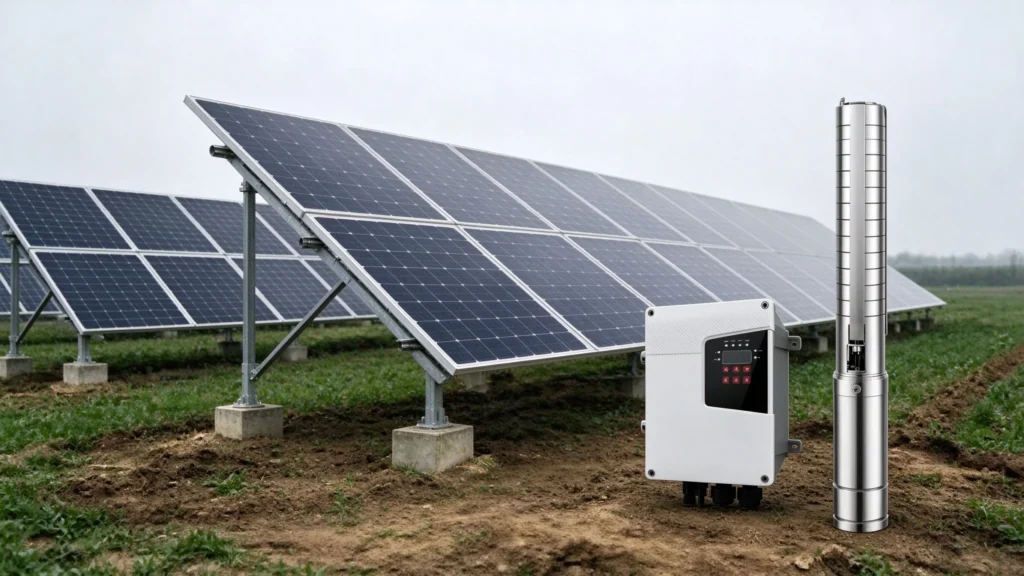
A solar irrigation system is not just a pump. It is the pump, the panels, the inverter or controller, the pipe network and the emission devices working as one. Sizing the pump without sizing the rest of the system is the most common mistake.
Start with the emission devices. Per FAO irrigation guidelines, drip irrigation typically operates at 0.5 to 2.5 bar (5 to 25 metres of head at the emitter): drip tape runs at the lower end (5 to 10 m), while pressure-compensating emitters need 10 to 30 m. Sprinklers need 25 to 40 m of head. Flood or furrow irrigation needs almost no pressure, only flow. Each of these changes the total dynamic head calculation even if the well depth is the same.
Then look at your water source. A shallow well or surface tank (less than 8 metres drawdown) can use a surface-mounted pump. A deep well (over 10 metres) requires a submersible pump installed below the static water level. Borehole diameter also matters: a 4-inch (100 mm) borehole accepts a 4-inch submersible pump; a smaller borehole needs a slimline unit.
The GIZ/FAO Solar Powered Irrigation Systems toolbox lists the same sizing sequence: crop water demand, source yield, head calculation, pump selection, panel sizing and storage decision. Working through that sequence before you buy prevents the most expensive errors in any solar irrigation pump project.
Choosing between a submersible and a surface solar water pump for irrigation depends almost entirely on your well depth and water level.
Submersible pumps hang fully submerged in the well below the static water level, on the end of the drop pipe. They are quiet, prime automatically and work in deep wells. We offer submersible pumps in 3-inch, 4-inch and 6-inch diameters, in both DC-only and AC/DC hybrid configurations. Our 4-inch series (95 mm diameter) alone covers 1.5 to 7.5 kW, flows from 3 to 14 m3/h and heads up to 355 metres. All wetted parts are AISI 304 or 316 stainless steel with sand-resistant impellers, which matters if your borehole carries fine sand.
Surface pumps sit on a concrete pad at ground level. They are easier to service and suited to shallow sources. Our ZSHF-ADHY series is a centrifugal surface pump with AC/DC hybrid MPPT control, ranging from 550 W to 3 kW. It handles flows up to 80 m3/h at heads of 14 to 24 metres, with outlet sizes from 1 to 5 inches. We also offer DC-only surface pumps and integrated controller units for smaller installations, so you can match the system complexity to your site rather than over-engineer it.
| Feature | Submersible Pump (4-inch) | Surface Pump (ZSHF-ADHY) |
| Well depth / suction | Installed below static water level, 40-355 m (4-inch series) | Up to 8 m suction lift |
| Power range | 1.5-7.5 kW (4-inch series) | 0.55-3.0 kW |
| Typical flow | 3-14 m3/h | 6-80 m3/h |
| Typical head | 40-355 m | 14-24 m |
| Borehole / installation | 4 in (95 mm) borehole, hangs on drop pipe | No borehole, sits on pad |
| Maintenance | Pull to surface for service | Easy ground access |
| Best for | Deep wells, high-head lift | Shallow water, high-volume low-head |
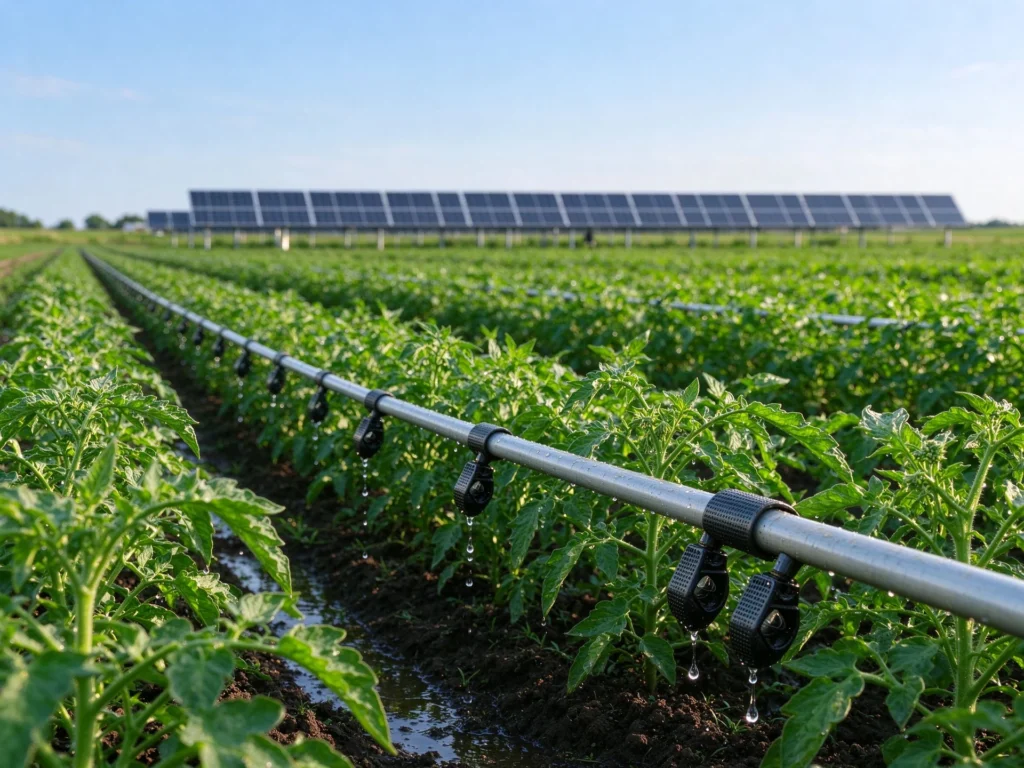
Once you know the required flow and head, use the hydraulic power formula from Step 3 to find shaft power, then round up to the nearest standard motor size.
Example: a farm needs 8 m3/h at 100 m head. Shaft power = (8 x 100) / (367 x 0.6) = 3.64 kW. With 25 percent derating for panels and pipe losses, specify a 5.5 kW motor. On our 4SP8-145-32-5.5 model, that combination delivers 8 m3/h at 145 m head, which covers the requirement with margin.
Panel wattage follows directly. A 5.5 kW three-phase pump driven by an MPPT inverter needs roughly 7 to 8 kW of solar panels in peak sun. The inverter’s DC input range (230 to 800 V on our ZFPV500 series) tells you how to wire panels in series: the panel open-circuit voltage must stay within the inverter’s DC input window across the whole temperature range.
Sample models from the 4-inch submersible series are shown below. The full range extends across more configurations; these are representative reference points.
| Pump Model | Power | Rated Flow | Rated Head | Suggested Panel Array |
| 4SP3-157-32-2.2 | 2.2 kW | 3 m3/h | 157 m | 3-4 kW |
| 4SP8-61-13-2.2 | 2.2 kW | 8 m3/h | 61 m | 3-4 kW |
| 4SP8-114-25-4.0 | 4.0 kW | 8 m3/h | 114 m | 5-6 kW |
| 4SP8-178-40-7.5 | 7.5 kW | 8 m3/h | 178 m | 9-10 kW |
| 4SP14-100-25-7.5 | 7.5 kW | 14 m3/h | 100 m | 9-10 kW |
A solar powered irrigation system can run direct from panels, or with batteries. The choice depends on when you need water.
Direct-drive systems run only during daylight hours. The pump starts once irradiance reaches the inverter threshold, ramps up as solar input rises, and stops in late afternoon. This works for most flood and drip irrigation where daytime watering is acceptable. Direct drive is cheaper because you skip batteries and charge controllers.
Battery-backed systems store solar energy for evening or timed irrigation. They are needed if you water at night, run timer-based drip cycles, or need constant pressure for a pressure tank. Batteries add cost and need replacement every 5 to 10 years depending on chemistry and cycling.
Most agricultural irrigation does not need batteries. Crops do not care whether water arrives at noon or 4 p.m. Reserve batteries for livestock watering that must run on a schedule, or for sites with heavy cloud cover where a direct-drive solar irrigation pump would deliver too few pumping hours.
Our MPPT solar pump inverters accept DC input from 230 to 800 V and drive 220 V or 380 V AC submersible motors directly. They include soft start, over-current protection and dry-run protection, so the pump shuts off if the borehole runs low.
Five mistakes account for most underperforming solar irrigation installs.
| Mistake | Consequence | Fix |
| Ignoring pipe friction loss | Pump delivers far less flow than rated | Add 10-20 m to vertical lift for long pipe runs |
| Sizing pump to borehole yield, not crop demand | Pump dries the well or cycles on dry-run protection | Match pump flow to sustainable borehole yield |
| Undersizing panels by 20 percent or more | Pump never reaches rated flow by mid-morning | Add 25 percent panel wattage for derating |
| No head margin for elevation changes | Flow drops when you extend the main line uphill | Specify pump at 80 percent of best-efficiency flow |
| Choosing plain 304 impeller in sandy water | Impeller wears out prematurely | Specify 304/316 with sand-resistant design |
HUOPSOLAR manufactures a broad solar pumping lineup: DC and AC/DC submersible pumps (3-inch, 4-inch and 6-inch), DC and AC/DC surface pumps, built-in controller integrated units, dedicated solar pool pumps, and standalone MPPT inverters for retrofit projects. For agricultural irrigation specifically, our 4-inch submersible series covers 1.5 to 7.5 kW, flows of 3 to 14 m3/h and heads up to 355 metres. The ZSHF-ADHY surface line covers 0.55 to 3 kW at flows up to 80 m3/h. All wetted parts are AISI 304 or 316 stainless steel, paired with MPPT inverters rated IP65. Whether you need a small solar irrigation pump for a half-hectare garden or a multi-kilowatt array for a commercial farm, the same solar irrigation pump sizing method applies.
Every pump carries CE, ISO 9001, GS and RoHS certification, and comes with a 2-year warranty on core components. We accept OEM orders and support pump selection based on your well depth, flow requirement and local sun hours. If you are comparing pump sizes or unsure which model matches your borehole, send us your well depth and daily water demand and we will recommend a configuration.
For 1 hectare of row crop, plan on 20 to 40 m3 per day as a typical range. A 2.2 to 3.0 kW submersible pump delivering 3 to 8 m3/h at 60 to 120 m head, paired with 3 to 5 kW of panels, covers most situations. Actual demand depends on crop and climate.
A 2 HP (1.5 kW) pump needs roughly 2 kWp of solar array in peak sun conditions. Using 550 W panels, that is about 4 panels. Add panels if your site has fewer peak sun hours or you need more pumping time per day.
Direct-drive solar pumps run only during daylight hours, typically 6 to 8 hours depending on season and site. To run at night or on a timer, add a battery bank sized to your daily energy use.
DC pumps run directly from panel voltage and are simpler for small systems. AC pumps use an MPPT inverter and drive standard three-phase motors; they scale better for 3 kW and larger irrigation loads.
Our 4-inch submersible models are rated up to 355 metres of head. Actual setting depth depends on pump rating, drop pipe rating and cable length; consult the pump curve before ordering.
Inspect panel cleanliness monthly, check electrical connections annually, and pull the submersible pump every 2 to 3 years to inspect impellers and seals. Most solar irrigation pump faults are wiring or dry-run trips, not pump failure.
A well-sized submersible pump in clean water typically runs 8 to 15 years before wear ring replacement. Surface pumps in clean water run 5 to 10 years. Sand-laden water cuts service life short, which is why sand-resistant impellers matter.
Match pipe diameter to flow: keep water velocity below 1.5 m/s. For 8 m3/h, use at least 50 mm (2 in) pipe. For 14 m3/h, use 63 mm (2.5 in) or larger. Undersized pipe adds friction loss that reduces delivered head.